
Understanding Wood Movement:
Seasonal Changes Every Woodworker Should Know
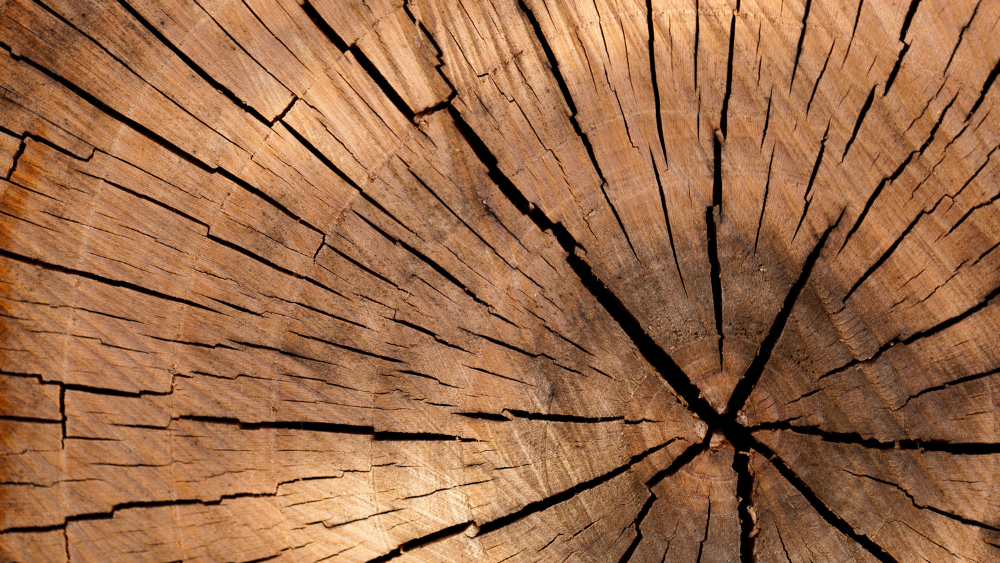
Wood is a living material. Even after it’s been milled, dried, and shaped into your project, it never truly stops moving.
Whether you’re a beginner cutting your first bowties or a seasoned craftsman building your own custom furniture, understanding wood movement is one of the most important skills you can develop. Ignore it, and your carefully crafted joints will crack, your panels will warp, and your drawers will stick every summer. Work with it, and your pieces will last generations.
Why Wood Moves
Wood is hygroscopic, meaning it constantly absorbs and releases moisture from the surrounding air. As humidity rises (typically in summer, and yes, even in Colorado!), wood absorbs moisture and expands. As humidity drops (typically in winter), wood releases moisture and shrinks. This cycle repeats every year, and your joinery needs to be designed to handle it.
Wood is always trying to reach its equilibrium moisture content (EMC): the point at which moisture is no longer entering or leaving the wood. Because a board’s EMC changes as relative humidity changes, unless wood is kept in a perfectly controlled environment, it is constantly shrinking and expanding. (Mother Earth News)
The amount of movement depends on two key factors:
- Wood species: Some species move dramatically, while others are relatively stable (such as Genuine Mahogany, White Oak, and Butternut)
- Grain orientation: How the board was cut from the log determines how much it moves and in which direction.
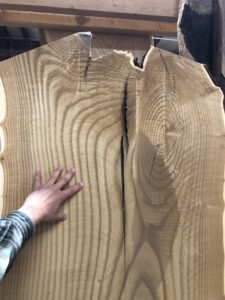
The Three Axes of Movement
Wood doesn’t move equally in all directions. Understanding the three axes is fundamental (Canadian Woodworking):
Longitudinal (along the grain): Movement along the length of a board is negligible (typically only 0.1% to 0.2%) and can be ignored for virtually all practical purposes. (Woodyard Interiors)
Radial (across the growth rings): Moderate movement, generally in the range of 2–8% depending on species. This is the primary direction quartersawn boards expand and contract. (Woodyard Interiors)
Tangential (perpendicular to the growth rings): The most significant movement, with total shrinkage ranging from roughly 5% to as high as 12% depending on species. This is the primary concern in flatsawn lumber – the most common type at the lumber yard. (Woodyard Interiors)
A simple rule of thumb: flatsawn boards move roughly twice as much as quartersawn boards of the same species. On average, flatsawn hardwood shrinks about 8% from fiber saturation to oven-dry, while quartersawn hardwood shrinks only about 4%. (Woodworkers Source)
Seasonal Changes: What to Expect
In most of North America, indoor relative humidity swings considerably between summer and winter, and that swing translates directly into wood movement in your projects. This is why dresser drawers and doors tend to stick in summer but are problem-free in winter. (Wagner Meters)
That movement isn’t a flaw… it’s wood behaving exactly as it should. Your job as a woodworker is to design for it.
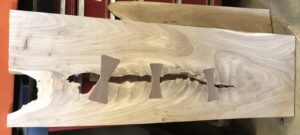
Practical Tips for Accounting for Wood Movement
1. Acclimate your lumber. Let rough lumber sit in your shop for at least 1–2 weeks before milling whether you’re doing it yourself, or outsourcing to a local mill. The goal is to bring the wood to the same moisture level as the environment where the finished piece will live. Establishing this equilibrium before you start cutting minimizes movement in the final product. (Wagner Meters)
2. Use elongated holes and figure-8 fasteners. When attaching a solid wood tabletop to a base, use hardware that allows movement. Never use rigid screws across the grain on wide panels.
3. Consider quartersawn lumber for demanding applications. For wide panels or any application where stability is critical, quartersawn lumber’s reduced movement makes it worth the premium. (Woodworkers Source)
4. Finish all sides equally. An unfinished bottom slows moisture exchange on one face, causing uneven movement and cupping. Always finish both faces of a slab panel.
5. Use a moisture meter. A handheld wood moisture meter lets you measure the actual moisture content of your lumber and track seasonal humidity in your shop. We like to have our hardwood sit between 7-8% in Northern Colorado. (Canadian Woodworking)
The Bottom Line
Wood movement isn’t a problem to be solved – it’s a property to be respected! Woodworkers who produce timeless, crack-free work aren’t fighting against the material; they’re designing with it in mind from the very first cut.
Take the time to learn how each species in your shop behaves, account for seasonal swings in your joinery, and your work will reward you for decades to come.
Baldwin Hardwoods’ Promise
As one of Northern Colorado’s most trusted hardwood suppliers, you can rest easy knowing that all of our slabs and lumber have been kiln-dried to ensure stability for our climate.
Ready to get started on your next design?
Browse our live edge slab inventory, or check stock on our hardwood lumber.